Wu Wei and the Exhaustion of Forcing Everything
I know there are others like me. We get caught up so much in life and so focused on controlling the outcomes of things that we stop paying attention to what this and every moment is actually trying to show us (or maybe, teach us). So what do we do? And how do we do that? We tighten that fist and our grip. We start overthinking. We start pushing too hard. I’ve even been guilty of trying to rehearse events and conversations in my mind even before they happen. In truth, though, we are actually only pushing ourselves further into places and positions that we don’t fully recognize. We are struggling to force clarity; we are struggling to force healing; we are struggling to force peace; and we are struggling to force people. Doesn’t that get exhausting?
When I get caught in life’s paradoxes, I like to lean on my love of the world’s wisdom across cultures. So with that, today I bring you to a Taoist philosophy called Wu Wei. Translated, Wu Wei means “effortless action” or “action without force.” At first glance, people commonly misunderstand the concept of action without effort as passive. It is not. They confuse it with laziness. Again, it is not. Wu Wei is not about giving up on life or just taking a nonchalant attitude about it. Instead, it is about moving through life and life’s challenges with an awareness of the events that transpire (with or without our control over them) rather than trying to fight the events currently around you. Friends, this is the difference between responding and reacting.
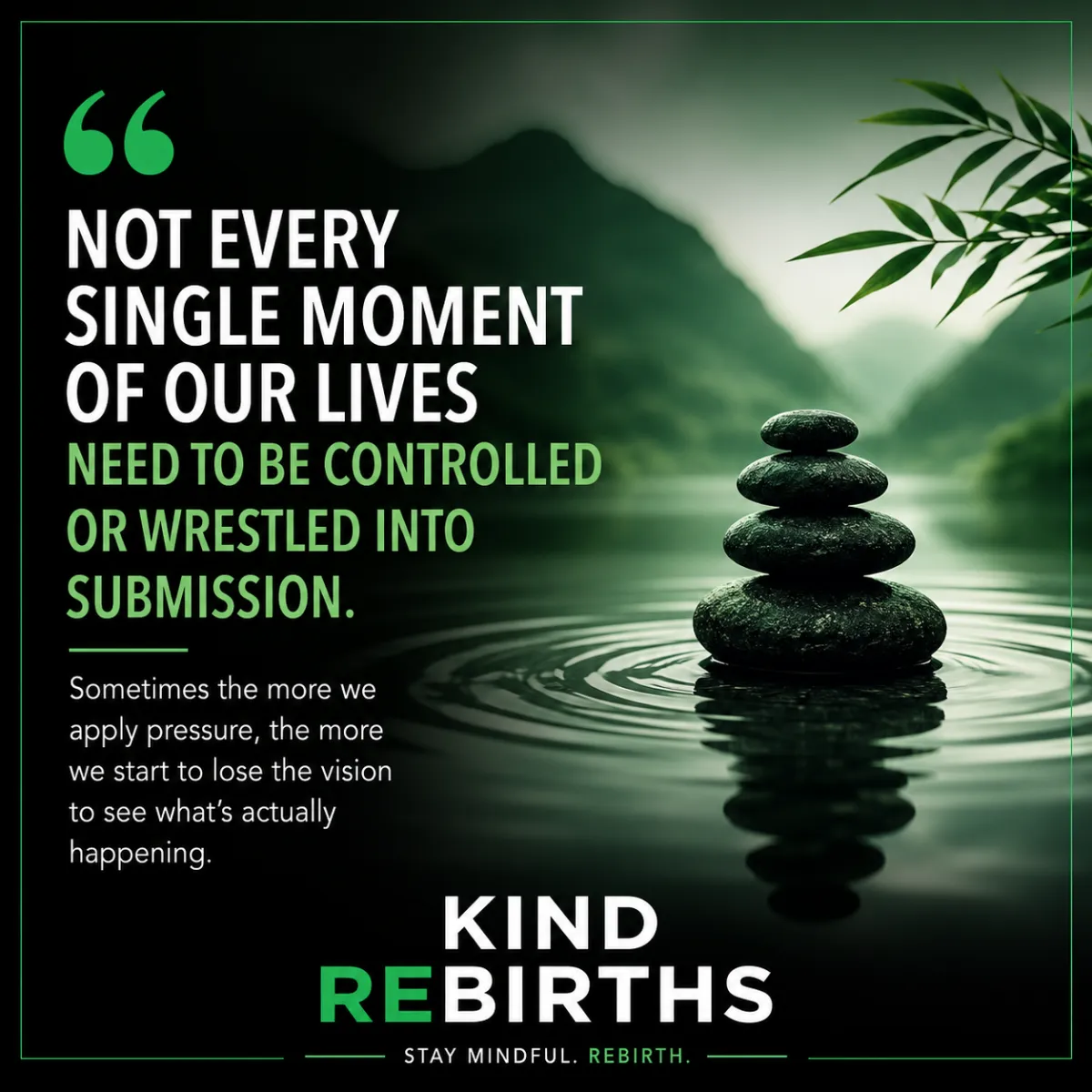
In the Kind Rebirths space, we consistently talk about developing and using mindful clarity and, of course, recognizing and being aware in real time. The principles of Wu Wei is a natural fit into that conversation because it is a reminder that not every single moment of our lives need to be controlled or wrestled into submission. If you notice carefully, sometimes the more we apply pressure, the more we start to lose the vision to see what’s actually happening.
Stress is known to develop from resistance. For me, when I reject change, I think about how many opportunities I lost from not adapting properly or how many missed opportunities I faced. Another huge one, not willing to let go and clinging to things that needed to be released. These are three common occurrences that come to mind immediately. But in either case, they are all stressors for me. And in large part, this is because humans are conditioned to fight change. We are conditioned to have a desperate need to control the timing of things, the outcomes of events, the perceptions and emotions of ourselves and of others, and the idea of uncertainty. For some reason, we have equated tension and stress with responsibility and integrity. In truth, we are adding to the separation that further disconnects us from the present moment. But the practices of Wu Wei invites a different approach. Like a Kind Rebirth, it asks us to notice what changes when awareness replaces unnecessary force.
This is not a focus on the need to stop caring. It does not mean we need to avoid difficult conversations or that we need to refuse to take action in certain situations. Conversely, it means our actions and movements become more aligned, driven less by the unfortunate consequences of panic, ego, or emotional disorder. Further, our instinct to act impulsively ideally will pause long enough to see with clarity. Instead of overpowering situations, we adapt and learn when to move; we learn when to wait; and we learn when to let the moment breathe. I find so much wisdom in that.
Some of us have spent years believing that life only responds to pressure. However, many important things cannot be forced into existence. Peace cannot be forced. Connection cannot be forced. Clarity cannot be forced. Sometimes rebirth is not about pushing harder; it’s about releasing enough of that resistance to allow yourself a return home. And that moment of clarity is a rebirth.
Stay Mindful…
Rebirth.
